We all want reform - why we need to get better at asking the 5 whys
5/11/20264 min read

There’s a temptation in politics, particularly in the wake of local elections, to look only at the headline. The slogan. The soundbite. The thing that people say out loud on a doorstep or in a comment section.
“Immigration.”
And so the political class, the media, and increasingly the public discourse itself becomes trapped in an endless cycle of reacting to the symptom rather than understanding the disease. But if there’s one thing I’ve learnt both in leadership and in life, it’s that surface-level explanations are rarely the full story. In healthcare, in organisational culture, in public safety — and yes, in politics — there’s a technique often used called the “Five Whys”. You keep asking why until you stop describing symptoms and start uncovering root causes.
Someone votes for a right-wing party.
Why?
“Because immigration is out of control.”
Why does that matter so deeply to them?
“Because they feel services are stretched and communities are changing too quickly.”
Why does that create anger rather than resilience?
“Because they already feel insecure, unheard, and left behind.”
Why do they feel left behind?
“Because wages have stagnated, housing feels unattainable, public services are deteriorating, and trust in institutions has collapsed.”
Why has trust collapsed?
“Because for years people have increasingly felt that politics is something done around them, not for them.”
And suddenly we’re no longer talking solely about immigration at all. We’re talking about belonging. Control. Economic insecurity. Community identity. Visibility. Trust. Dignity.
That doesn’t mean every concern expressed by voters is automatically rational, fair, or rooted in fact. Nor does it mean we should blindly validate every narrative pushed by populist movements. But dismissing people outright has become one of the greatest strategic failures of modern politics. If large numbers of people are angry enough to fundamentally reshape the political landscape, then responsible leadership requires curiosity before condemnation. The problem with many mainstream parties is that they’ve become highly skilled at rebuttal, but increasingly poor at listening.
When someone says, “I’m worried about immigration,” the instinctive response is often statistical correction. GDP contribution. Labour shortages. Net migration charts. And while facts matter, facts alone rarely resolve emotional dislocation. Because often the underlying message is not: “I hate foreigners.”
It is: “I no longer recognise the social contract I was promised.”
That distinction matters enormously. If someone cannot get a GP appointment, cannot afford rent in the town they grew up in, sees their high street declining, feels culturally disconnected from decision makers, and believes nobody in power is willing to even acknowledge their frustrations — then eventually somebody else will step forward and say: “I see you.”
Even if their solutions are simplistic. Even if their politics are divisive. Even if their diagnosis is incomplete. People are drawn towards those who appear to listen. And this is where I think many progressives and centrists have lost ground. Not because compassion is wrong. Not because diversity is wrong. Not because openness is wrong. But because too often legitimate anxieties have been treated as moral failings instead of opportunities for meaningful conversation.
You cannot shame people into trust. Nor can you rebuild fractured communities through performative outrage on social media. The uncomfortable truth may well be that immigration has become the vessel into which a much wider set of frustrations have been poured. Frustration about economic decline. About social fragmentation. About loss of identity. About perceived unfairness. About institutions that feel distant and managerial rather than human. If we only debate immigration itself, we risk endlessly arguing over the smoke while ignoring the fire.
The Five Whys forces us to go deeper. Why are people angry? Why are they disconnected? Why do they feel politically homeless? Why has faith in mainstream institutions weakened? Why are communities becoming more vulnerable to polarisation? Those are harder questions. But they are the necessary ones. And importantly, asking those questions is not the same as endorsing extremism. In fact, it may be one of the only ways to prevent it. Healthy democracies require more than voting systems and manifestos. They require people to feel heard, represented, and connected to a future they still believe contains a place for them. When those things disappear, politics stops becoming hopeful and starts becoming reactive. Fear fills the vacuum.
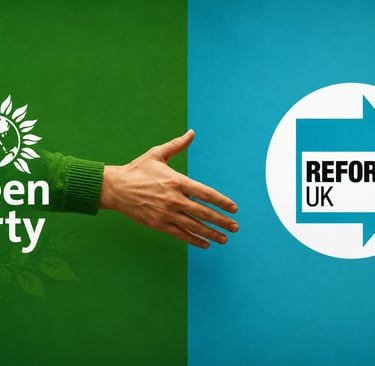
For parties like the Green Party, I think there is also a moment of reflection required here. If politics rooted in compassion, sustainability, fairness, and community genuinely wants to grow, then it cannot only speak to those who already agree with it. It must also be willing to engage with those currently finding a home in movements like Reform UK or Restore Britain — not from a position of superiority or dismissal, but from a position of curiosity, empathy, and confidence. Not every voter drawn towards those parties is motivated by hatred or division. Many are searching for certainty, identity, security, and a sense that somebody finally understands their frustrations. If progressive politics immediately labels those people rather than listening to them, it simply drives them further away.
The challenge, therefore, is not how to “defeat” those voters, but how to bring them along. How do we offer solutions rooted not in fear, but in hope? How do we build stronger communities, affordable housing, functioning public services, secure jobs, cleaner streets, and a renewed sense of local pride in ways that people can tangibly feel in their everyday lives? Because if people feel economically secure, socially connected, and listened to, the politics of anger becomes far less powerful. Real leadership means having the courage to step into difficult conversations without instantly turning them into battle lines, and instead asking: what is the unmet need sitting underneath this frustration, and how do we solve it together?
The answer, I suspect, is not to simply shout louder at each other across ideological trenches. It is to rebuild trust at community level. To restore competence in public services. To create genuine economic opportunity. To foster belonging without requiring division.
And above all, to rediscover the ability to listen without immediately dehumanising those we disagree with.
Because if we never ask the deeper “why”, we will spend the next decade fighting symptoms while the underlying fracture quietly widens beneath us.